A cough or shortness of breath does not point to one test. Spirometry may identify airflow narrowing, while imaging, oxygen measurements, sputum analysis or heart testing may answer a different question. By the end, you can match common symptoms and risk factors with the test that needs priority and know when routine testing is unsafe.
Key takeaways
- Spirometry measures FVC, FEV1 and the FEV1/FVC ratio.
- Seek urgent care for severe breathlessness, blue lips, confusion or chest pain.
- Smoking history changes which causes and tests clinicians prioritise.
- A normal spirometry result does not end the evaluation of persistent symptoms.
What a pulmonary function test actually measures
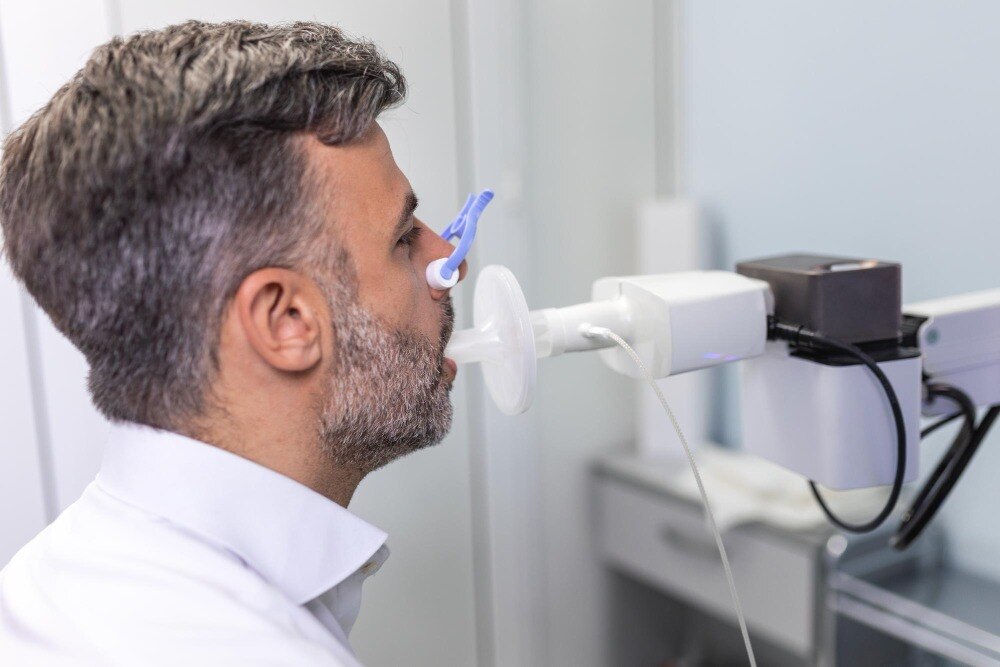
Spirometry is the starting test for cough or breathing difficulty. It measures how much air you move and how quickly: forced vital capacity (FVC) is the total air forcefully exhaled, forced expiratory volume in one second (FEV1) is the amount expelled in the first second, and the FEV1/FVC ratio shows airflow obstruction.
For a cough pulmonary function test in Pune, the clinician may add a bronchodilator test. You inhale medicine, repeat spirometry, and compare FEV1 or the ratio; a significant improvement supports reversible airway narrowing, as seen in asthma.
Peak expiratory flow records your fastest blow, useful for tracking day-to-day or work-related variation, but it is less complete than spirometry.
| Test | What it measures | What the result can show |
|---|---|---|
| Lung-volume testing | Total lung capacity (TLC), residual volume and other volumes | Low TLC suggests restriction; high volumes can indicate hyperinflation or air trapping |
| DLCO | Transfer of carbon monoxide from air sacs into blood | Low gas-transfer capacity can support emphysema, interstitial lung disease or pulmonary vascular disease |
| Six-minute walk test | Distance, symptoms and oxygen saturation during walking | Shows functional limitation or exertional oxygen desaturation |
| Cardiopulmonary exercise test | Breathing, heart response and gas exchange during exertion | Helps separate ventilatory, circulatory, gas-exchange and deconditioning patterns |
Breathing difficulty lung testing does not directly measure oxygen saturation, infection or heart function. A normal result also does not exclude intermittent asthma, reflux, upper-airway cough or cardiac breathlessness. DLCO requires interpretation alongside haemoglobin and your clinical history.
Which test can find the cause behind your symptoms?
No single test identifies every cause. A pulmonary test for shortness of breath is strongest for detecting airflow limitation, restricted lung volumes and impaired oxygen transfer; other tests look for infection, structural disease, low oxygen, heart dysfunction or vocal-cord problems.
| Test | Main question answered | What it can show |
|---|---|---|
| Pulmonary function testing | Are the airways narrowed or the lungs restricted? | Spirometry, bronchodilator response, lung volumes and DLCO can identify obstruction, restriction or reduced oxygen transfer. Normal spirometry does not exclude asthma, reflux-related cough or early lung disease. |
| Chest X-ray or high-resolution CT | Is there visible structural disease? | X-ray can support pneumonia or tuberculosis assessment. CT is more sensitive for emphysema, bronchiectasis, pulmonary fibrosis and some embolic complications; a chest X-ray cannot confirm COPD. |
| Pulse oximetry or arterial blood gas | Is oxygen exchange failing now? | Pulse oximetry estimates blood oxygen saturation. An arterial blood gas measures oxygen, carbon dioxide and acidity, including problems a normal breathing test can miss. |
| Sputum testing | Is infection present? | Microscopy, culture and tuberculosis testing examine mucus for bacteria, fungi or mycobacteria. |
| Heart or airway examination | Is the cause cardiac or in the upper airway? | Echocardiography assesses heart pumping and valve disease. Laryngoscopy examines vocal-cord dysfunction; bronchoscopy inspects the airways and can collect samples. |
For exertional symptoms that resting spirometry does not explain, a six-minute walk test measures functional limitation, while cardiopulmonary exercise testing separates ventilatory, circulatory, gas-exchange and deconditioning patterns. Interpretation still depends on your history and examination.
When should you arrange testing, and when is it urgent?
Book routine assessment for a stable cough lasting more than three weeks, recurring wheeze, or breathlessness that appears with exertion and has not suddenly worsened. If you are searching for a pulmonary function test in Pune because of a cough or breathing difficulty, arrange a clinical review first; spirometry is not a substitute for examination.
| Situation | Warning signs | Action |
|---|---|---|
| Routine assessment | Stable cough, exertional breathlessness, intermittent wheeze, or reduced exercise tolerance | Arrange a PFT appointment and review your medication, smoking exposure and medical history. |
| Prompt investigation | Recurrent chest infections, coughing up blood, unexplained weight loss, new or worsening breathlessness, fever, or breathlessness after a recent illness | Contact a clinician promptly. You may need pulse oximetry, a chest X-ray, blood tests or imaging before lung-function testing. |
| Emergency care | Severe or rapidly worsening breathing difficulty, inability to speak in full sentences, blue lips or face, confusion, severe chest pain, or coughing up more than a small amount of blood | Seek emergency care immediately rather than attending a routine PFT appointment. |
Do not wait for testing if symptoms are severe. Call local emergency services, sit upright and avoid driving yourself. A normal oxygen reading or earlier spirometry does not overrule a sudden change. Stable symptoms still need interpretation alongside examination because a PFT cannot diagnose every cause of cough or breathlessness.
How smoking history changes a cough evaluation
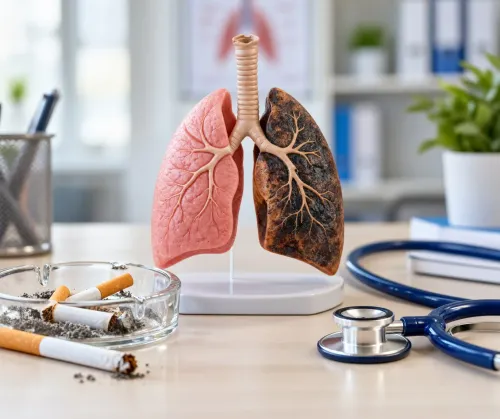
A smoking-related cough assessment starts with exposure details, not simply the word “smoker.” Record cigarettes per day, years smoked, pack-years, quit date, vaping, biomass-fuel exposure and workplace dust. Ask about sputum, wheezing, exertional breathlessness, repeated infections, coughing blood and weight loss.
A cough pulmonary function test in Pune usually starts with spirometry before and after a bronchodilator. COPD requires post-bronchodilator airflow obstruction plus compatible symptoms and exposure history; smoking alone is not a diagnosis. If spirometry suggests emphysema or restriction, lung volumes and DLCO can show trapped air, reduced capacity or impaired oxygen transfer.
Use this checklist when normal spirometry does not explain the cough:
- Check oxygen saturation and examine the nose, throat, chest and heart.
- Request a chest X-ray for persistent cough, recurrent infection, coughing blood, weight loss or unexplained breathlessness; consider CT when structural disease remains a concern.
- Investigate asthma with serial peak-flow readings, bronchodilator testing, FeNO or bronchial challenge testing when symptoms come and go.
- Assess reflux, post-nasal drainage, bronchiectasis and cardiac disease separately; spirometry cannot diagnose them.
- Stop smoking now rather than waiting for testing.
At Dr Kunjir's Brio Clinic, the useful decision is whether your history requires imaging, expanded lung testing or another specialist examination despite a normal result. Normal spirometry rules out neither intermittent airway narrowing nor every serious cause of cough.
What to do when the first test is normal or inconclusive
A normal spirometry result does not end the investigation: it measures airflow at one appointment, not every cause of cough or breathlessness. Ask whether breathing difficulty lung testing needs repeat spirometry during symptoms, bronchodilator testing, lung-volume measurement or DLCO.
| Test | What it can explain | When it helps |
|---|---|---|
| Serial peak-flow readings | Variable airway narrowing | Asthma is suspected but spirometry is normal between episodes |
| FeNO or bronchial challenge testing | Eosinophilic airway inflammation or airway hyper-responsiveness | Asthma remains possible after non-diagnostic spirometry |
| Lung volumes and DLCO | Restriction, hyperinflation or impaired oxygen transfer | Breathlessness persists despite near-normal airflow results |
| Six-minute walk test | Oxygen desaturation and real-world exercise limitation | Symptoms occur mainly while walking or climbing |
| Cardiopulmonary exercise test | Ventilatory, circulatory, gas-exchange or deconditioning patterns | Exertional symptoms remain unexplained |
| Chest X-ray or high-resolution CT | Infection, tuberculosis changes, emphysema, fibrosis or structural disease | Cough persists, examination is abnormal, or lung disease is suspected |
| Echocardiography and ECG | Heart-related breathlessness or rhythm problems | Breathlessness includes swelling, chest discomfort, palpitations or faintness |
DLCO interpretation needs the haemoglobin level and clinical history; anaemia can reduce the measured value. A normal chest X-ray does not rule out asthma, and a normal pulmonary test for shortness of breath does not exclude reflux, upper-airway cough syndrome or vocal-cord dysfunction. Persistent symptoms deserve review rather than repeated testing without a specific question.
Frequently asked questions
What does a pulmonary function test measure for cough or breathing difficulty?
Spirometry measures forced vital capacity (FVC), forced expiratory volume in one second (FEV1) and the FEV1/FVC ratio to assess airflow and obstruction.
Which test can find the cause of cough or breathing difficulty?
Spirometry is a starting point, while a chest X-ray, bronchodilator testing, full pulmonary function tests, FeNO testing or other investigations fit different suspected causes.
When should breathing difficulty be treated as urgent?
Seek urgent medical care for severe or rapidly worsening breathlessness, blue lips, confusion, fainting, chest pain or inability to speak full sentences.
How does smoking history change a cough evaluation?
Tell the clinician your smoking duration, daily amount and vaping or tobacco exposure because this changes the assessment for chronic airflow limitation and other lung disease.
What happens when spirometry is normal or inconclusive?
Your clinician can review technique and exposure history, repeat testing, perform bronchodilator or full lung-function testing, and consider imaging or tests for other causes.
Keywords